
TypeMatrix and Dvorak
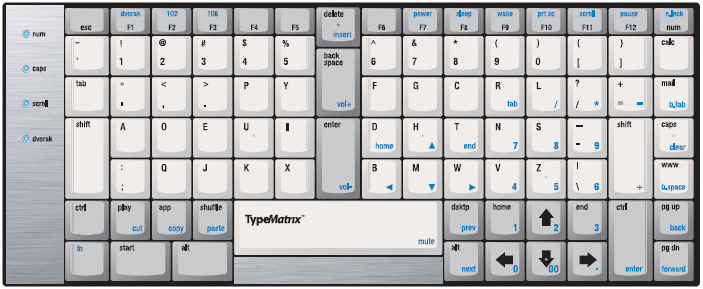
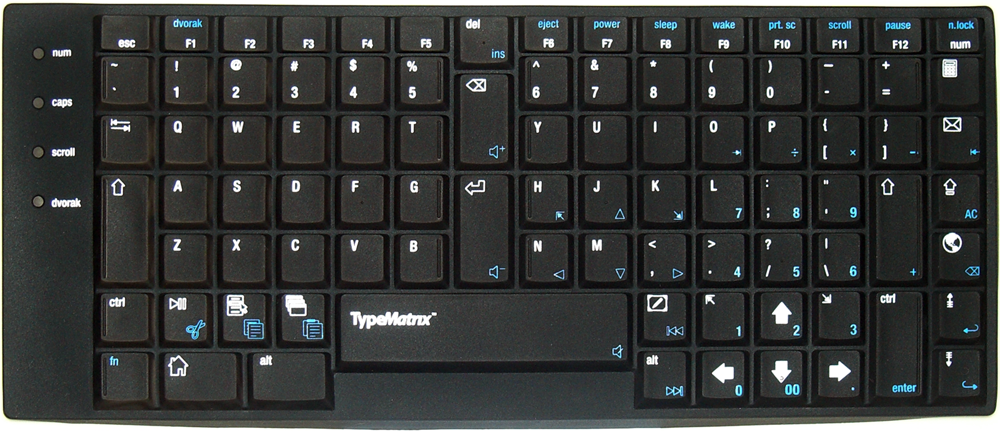
The current QWERTY keyboard was designed in 1872 for two-fingered "hunt and peck" typists. But it became the standard and has survived to the 21st Century basically unchanged.
August Dvorak invented the Simplified Keyboard (as he called it) in 1932 as a result of exhaustive time and motion studies. The Dvorak Keyboard (as the Simplified Keyboard is now known) has been only marginally necessary until the widespread use of computers.
Now, Repetitive Stress Injuries (RSI) are a major factor for anyone who spends even a few hours a day working with a keyboard. The Dvorak Layout reduces finger movement by more than 50%, and hence is "just what the doctor ordered" for those suffering RSI.
A light-hearted introduction to Dvorak by the folks at whatyououghttoknow.com
Users of the Dvorak Keyboard may be faster and make fewer errors than an equally qualified QWERTY typist, but most importantly, stress on the fingers, hands and wrists is greatly reduced.
A brief introduction to Dvorak and its benefits by JamesManOfStone
TypeMatrix EZ-Reach keyboards are ALL switchable to Dvorak without any software.
To find out more about Dvorak from real enthusiasts visit The Dvorak zine.
History of Dvorak
In the beginning... In 1872, when Christopher Sholes invented the first practical typewriter, he was faced with a serious problem: his typists constantly jammed their machines. They were typing too fast. His solution was the only one available: he rearranged the keys to slow down the typists! That keyboard layout is still in use today. We know it as the QWERTY keyboard.
Touch typing (using all 10 fingers) started to catch on in the 1880s. The QWERTY layout became the standard, but it had serious problems, having never been designed for touch typing.
1930s — Dvorak creates the Simplified Keyboard. Researchers Frank and Lillian Gilbreth made slow motion films of expert typists at work. Professor August Dvorak and William Dealey saw the problems inherent in QWERTY — limited speed, too many mistakes, quick fatigue and pain (what we now call RSI). By 1932, they had a keyboard layout that reduced finger movement by an order of magnitude (10 times).
During World War II, the Navy confirmed the Dvorak layout was vastly superior to QWERTY. But the standard layout was too entrenched.
The Computer Age... The Apple IIe had the Dvorak layout built in. When Windows arrived, Dvorak became available through Settings → Control Panel → Keyboard → Language → Properties.
With TypeMatrix keyboards, switching is invisible to the computer — press Fn + F1 to toggle.
Learning Dvorak
An accomplished QWERTY typist will take about 100 hours to transition. Once the transition is made, the Dvorak typist will usually type faster, with a lower error rate and with reduced fatigue and injury.
Short, daily practice sessions will minimize the transition time. Some touch-typists have learned Dvorak in 25 hours. Barbara Blackburn, who failed her High School Typing class, switched to Dvorak 60 years ago and became the world's fastest typist at over 200 words per minute!
If you are experiencing pain or fatigue, have RSI, or would like to increase your speed and accuracy, the Dvorak keyboard is for you. With TypeMatrix keyboards, switch by pressing Fn and tapping Dvorak.
Articles about Dvorak
- The Curse of QWERTY — Jared Diamond, Discover Magazine, 1997
- Make Mine Dvorak — Nicholas Thompson, Slate Magazine, 2002